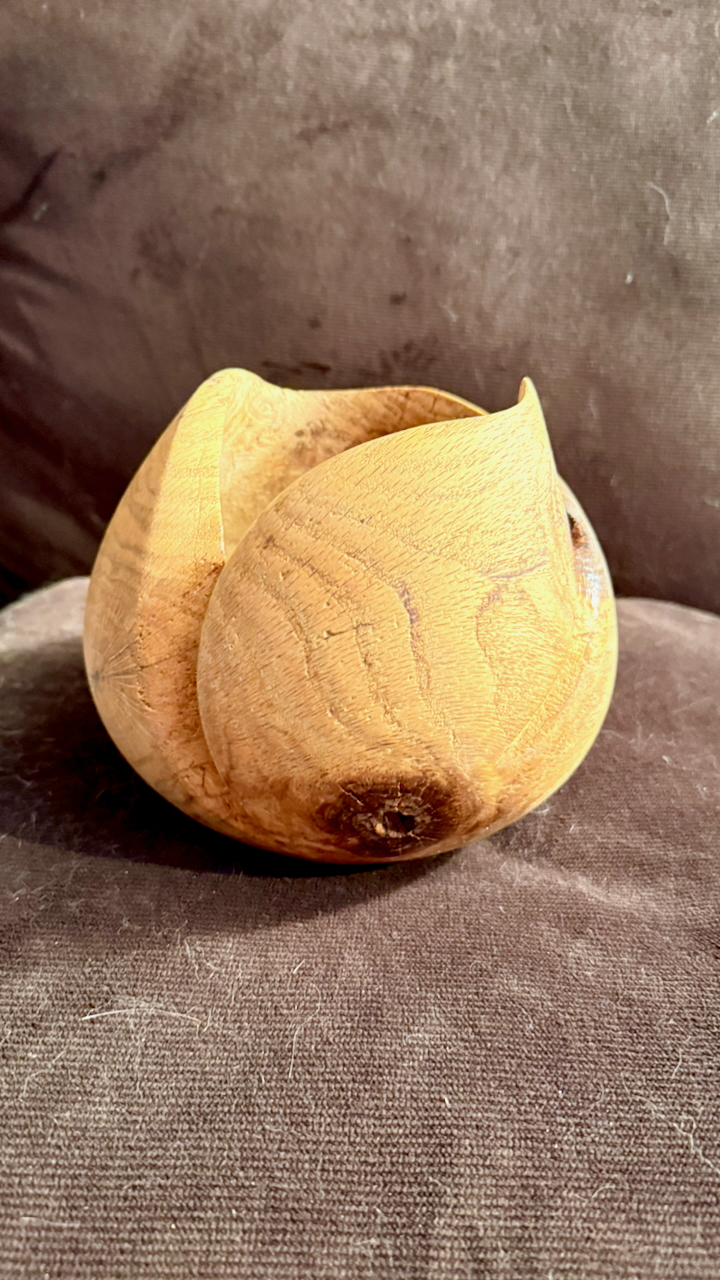
The wing shape emerged from carving a V down the center of the hollow form, splitting the "breast" and exposing grain. The wing formed from there — not preconceived.
Process
Turned on lathe as hollow form, then carved. The piece was driven by interest in combining carving with turning.
Name Origin
The wing shape revealed itself through the carving process. Name came from what the form became.
Intentionality
Experimental — more interested in applying carving to a form than in the hollow form itself
Type
hollow form
Date Created
September 2025 (approximate)
Ownership
Still in artist’s possession.
Finish
Walnut oil only. No shellac or wax yet.
Origin Story
Salvaged oak found on the side of the road near the artist’s gym — trainer told him about it. Oak isn’t a lovely turning wood, so it started as an experiment. The real interest was in applying carving to a turned form rather than making another hollow form.
red oak Likely red oak due to large pore size. Not a lovely turning wood.woodsalvaged
Formal Elements
voidHollow interior space, opening into the formwhat opens when you stop filling yourself, revelation, emergence
open formForm that unfurls, receives, makes space for what isn't there yetreceptivity, offering, space for connection
Embodies
damage-as-material 2026-03-10T16:56:05.979ZThe damage was the material all along. Not damage overcome, not damage redeemed, not beautiful-despite-broken. The rot is the color. The void is the form. The chainsaw scar is the first mark in a collaboration the chainsaw did not know it was starting. Damage is not precondition; damage is content.